
| 7. |
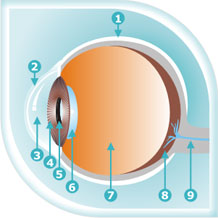
The light from the lens passes through the vitreous body which is the biggest part of the eye, forms two thirds of the eye's volume and gives the eye its shape. It is filled with a clear, jelly like material called the vitreous humour. After the light passes through the lens, it shines straight through the vitreous humour to the back of the eyeball. |
|
| 8. |
At the very back of the eyeball is the retina which holds millions of cells called rods and cones to process light. Rods see in black, white and shades of gray and allow us to see even when it's very dark. Cones sense colour and require light to function properly. Cones are of three types each sensitive to shades of either red, green or blue. Together, these cones can sense combinations of light waves that enable our eyes to see millions of colours. |
|
| 9. |
The colours and image sensed by the retina is then informed to the brain with the help of nerves called the optic nerves. The brain then logically identifies what the eye sees, thereby helping our minds to relate to it. |
|
| |
|
|
| structure of the eye contd. 1 2 |
|
| Now that we know the mechanism, let’s look at a few tips for eye care. |
| |
| |
| |
| |
| |
| |
| |
| |
|
 |